 |
and now seeing that the new church book is not true to this faith I find it necessary to tell you that I cannot keep to this new church book and that I must again take up the old one.
Accordingly my dear Andreas and Moritz congregation may wish to change its decision concerning me. One appointed from each Christian parish may write me as soon as possible as to whether or not he thinks under these circumstances the parish can retain me as its minister and spiritual caregiver. As a decision is made, I ask that each not regard my personage or consider any preference towards me, for that I do not deserve; rather let each look to the Word of God and to the faith, which he has learned from the scriptures and inherited from his fathers. Should you wish to question me further on my grounds for this or any other thing, which transpires between us, personal access is granted as is customary and ever available. Hereby I conclude with a heartfelt and urgent plea that a hasty decision not be made but rather that one weigh whether he may be able to justify his decision before God. Also do not decide hastily about other churches and ministers, who continue to use this new agenda with easy conscience. Each may continue to use it until such time as he acknowledges that he no longer wishes to or is able to use it. Concerning this we must not decide or judge hastily and it would bring me great sorrow if any one of my beloved parishioners did so. I ask once again: Judge not, lest you be judged; condemn not, lest you be condemned; rather let us judge ourselves for all times. While looking forward to the written brief declaration of each parishioner, to be sent in as soon as possible, I ask each to lay his justification before God and I hope each will receive grace from above and enlightenment from the Holy Spirit for this matter is neither as easy or superficial as many might seem to think. God be with us! Amen. This announcement in connection with the sermon on profession, which we communicated above in abridged format, created much excitement. The congregation for the most part acknowledged with their |
 |
Pastor the transgression of the Union and openly professed it. The result was that Pastor Grabau was suspended from the ministry by the royal government because of his beliefs; during the suspension he was brought before the Police Commissioner, who was the representative of the church, and he later suffered persecution, imprisonment and all manner of adversity. As fate would have it by God's grace there was a general awakening from the union sleep and speakers for Lutheran doctrine arose in Silesia, Saxony, Thuringia and other provinces; many true Lutheran pastors sided with him and for this they were suspended, prosecuted, banished and hunted down. Amid all this suffering however he held steadfastly to Christ's Word and Promise and comforted himself with the Word of Christ: "Blessed are they who suffer slander and persecution for my sake. They shall find their reward in heaven."
On the following Sunday, the 16th after Trinity, the Andreas Church was taken over by the gendarmerie and the police and a united consistory councilor seized the pulpit. The congregation was assembled in great number and it was filled with great distress, for its beloved pastor and spiritual caregiver had been banned from the pulpit and forbidden to represent the church. A great number went after the church service to the rectory and stayed there until late at night with their spiritual caregiver, seeking advice and comfort for their troubled souls. On the next Sunday the church was empty and the rectory was full of Christians, to whom Grabau delivered the word of life. And although this too was forbidden, one recognized that one must listen in such matters to God rather than man. Because the rectory could not longer hold the multitude, one of the congregation, a pious master miller by the name of Fils, made available the upper floor of his mill, called Storch's Mill, which was located beyond the Johannis Gate. From then on the assembly held its church services there. The Christians, who attended the Lutheran church services there, were subsequently punished with fines and confiscations of property. Also those Lutheran Christians, who would not send their children to the United School, were plagued with financial penalties. Bishop Dräseke hoped to move Pastor Grabau through persuasion to recant; this transpired for two days, October 5th and 6th. He talked 1. of the united church agenda; |
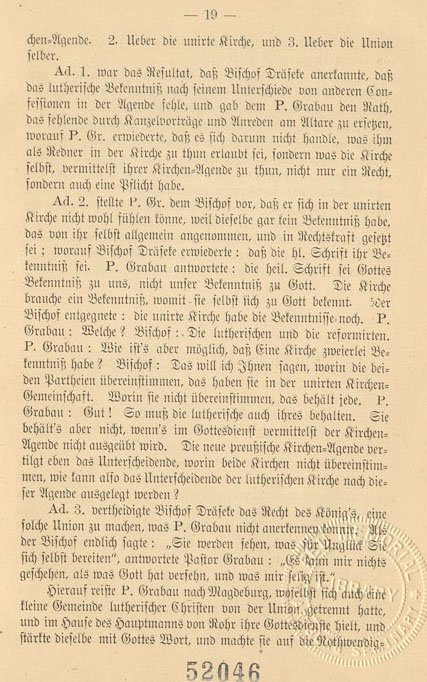 |
2. about the united church and 3. about the union itself.
Concerning Point 1. the result was that Bishop Dräseke acknowledged the differences between the Lutheran profession of faith and the shortcomings of other confessions in the agenda and he advised Pastor Grabau to supplement the shortfalls through pulpit lectures and speeches from the altar. To this Pastor Grabau responded that it couldn't be handled this way; he had not only the right but also the duty to speak about the church and not only the church itself but how it was mitigated by the church agenda. Concerning Point 2. Pastor Grabau apprised the Bishop that he did not feel comfortable with the united church because it did not have a profession, which had been generally accepted; rather it had been enforced through law. Concerning Point 3. Bishop Dräseke defended the right of the king to make such a union, but Pastor Grabau could not acknowledge this. As the Bishop said in conclusion, "You will see what misfortune you make for yourself," Pastor Grabau answered, "Nothing can happen to me except what God provides and what is sacred to me." Afterwards Pastor Grabau traveled to Magdeburg, where a small congregation of Lutheran Christians had also separated from the Union and in the home of Captain von Rohr the congregation held its church service and strengthened itself with the Word of God and of necessity made its |
 |
statement of public and lawful withdrawal from the united church, which was also effective immediately.
Pastor Grabau, as soon as he returned to Erfurt, submitted his withdrawal from the united church in writing to the Consistory. A large portion of the Andreas congregation withdrew with him. Since attendance at church services in Storch's Mill had been hindered by police force, services were held at various houses at night, especially in the so-called Brühler suburb. And although the police ferreted out these church services in the homes and executed their orders to suppress them, many of the police were ashamed of such sinful conduct. Confiscated materials were carried through the streets and one often made fun of the Lutheran Religion's police force. The persecuted congregation however grew in ever greater membership until it numbered between 70 and 80 families and around 20 unmarried persons. IV. A Report from the Year 1837 In a pamphlet published in 1837 by M. Ernst titled "The History of Persecution of the Lutheran Church in Prussia" we read the following report of events: "Erfurt, once such a famous city in the history of the Reformation, up to this point showed no further signs of newly awakening Lutheran life although the vestiges of good morals and loyalty to faith still remained dormant within this city, one of the old German free cities of the empire. Through communiqués delivered to outspoken Christians of Erfurt they learned of the deportations (of the Lutheran Pastors of Silesia); circulating pamphlets became the order of the day. One pastor by the name of Grabau, who had blessedly ministered for quite some time, openly spoke from the pulpit to his congregation about this Prussian intrusion and professed his return to the Lutheran Church. He assembled a congregation. |
 |
Because of this, activity stirred anew throughout Thuringia. Pastor Grabau was immediately suspended and a foreigner seized his pulpit, preaching before the public of the new Prussian-Evangelican virtues of love, charity and moderation while at the same time even in the church Prussian swords and bayonets kept watch. Overall resentment soon presided and only crucial words from the suspended pastor kept the people, driven almost to the point of extreme action, in check. The church in Thuringia became reinvigorated and the Erfurt congregation organized and grew; the entire congregation petitioned the King for the reinstatement of its pastor or at least for the appointment of a Lutheran pastor because the congregation was Lutheran; if this was not granted, with the exception of a few members, the Lutheran congregation of Pastor Grabau was willing to depart. Instead of a response the following substantiated actions came to pass: On March 1, 1837 at 3 PM Pastor Grabau was summoned before the magistrate, supposedly to give further testimony. When he appeared, Magistrate Wagner informed him that the Erfurt government had ordered his removal from here because he would not submit, upon their order, to cease his ministry. He was deported on that same day. Pastor Grabau replied that in this case he must return to his house in order to get what he needed for the journey and to tie up other matters. Up until the issuing of the government order, the magistrate had affected all manner of courtesy, assuring the pastor that he would not be persecuted; now he threw off the disguise and showed his true face. He slammed the door shut so that Pastor Grabau could not leave and said: You can write your wife and tell her what you need. The pastor complied, wrote to his wife and his one-year old son, reporting the grounds and telling her what things he would need.
The good woman was not in the least disconcerted, rather she hastened to the magistrate accompanied by her maid (the current housemother of our Martin Luther College, Widow Detter, a true friend who in her mastery of Christianity turned all sadness to joy for the sake of Christ). |
Return to Table of Contents
Text provided by the Reu Memorial Library, Wartburg Seminary, Dubuque, Iowa - Call No. BX8080.G72 G7
Continue to Pages 22 - 26
Edited January 17, 2006
Imaging and Translation by Susan Kriegbaum-Hanks
